


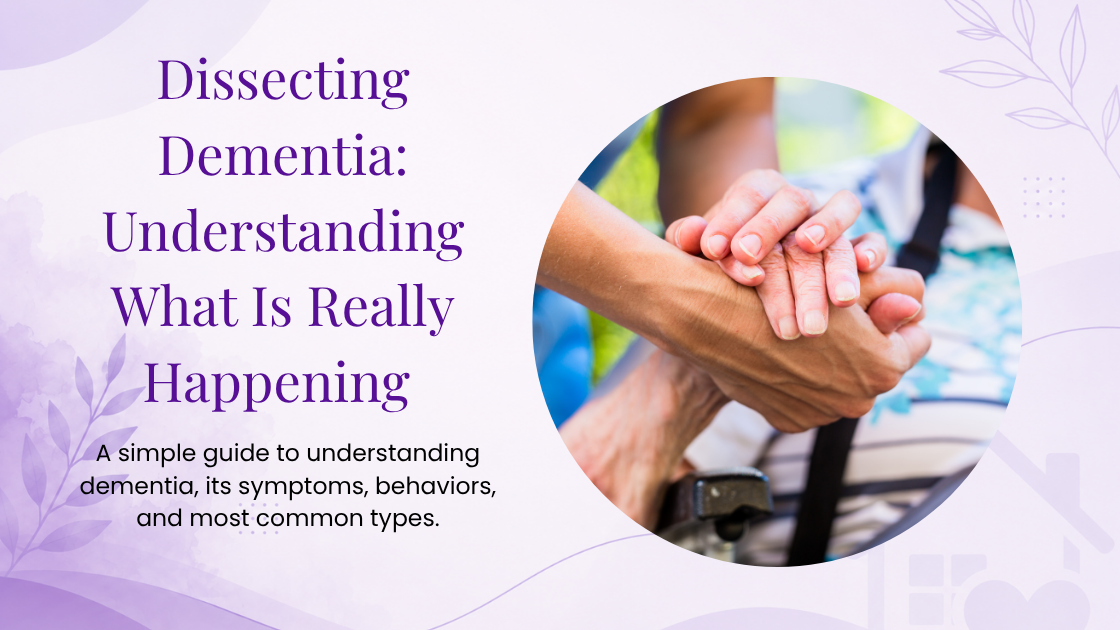
Dissecting Dementia: Understanding What Is Really Happening to Your Loved One
Let’s dissect dementia in order to really understand what is really happening to your loved one.
Maybe Mom has started accusing people of moving her belongings.
Dad becomes angry when you try to help him get dressed.
Your spouse asks the same question five times within 20 minutes.
Or perhaps the person you have known your entire life simply seems… different.
When families first begin noticing these changes, memory loss is often the first thing they associate with dementia. But dementia is much more complicated than forgetting names, dates, or where the keys were placed.
Dementia can affect the way a person thinks, communicates, processes information, interprets their surroundings, controls emotions, makes decisions, moves, sleeps, and behaves.
To better care for someone living with dementia, it helps to understand what is happening beneath the surface.
First: What Exactly Is Dementia?
One of the biggest misconceptions about dementia is that it is a single disease.
It isn’t.
Dementia is an umbrella term used to describe a group of neurological conditions that cause changes in memory, thinking, reasoning, behavior, and a person’s ability to function independently. Alzheimer’s disease is the most common type of dementia, but it is not the only one.
Another important distinction: dementia is not a normal part of aging.
Occasionally forgetting someone’s name and remembering it later can happen as we age. Dementia involves changes significant enough to interfere with everyday life—such as becoming lost in a familiar neighborhood, struggling to complete familiar tasks, having significant difficulty communicating, or experiencing changes in judgment and reasoning.
What Is Actually Happening Inside the Brain?
Our brains contain billions of nerve cells called neurons. These cells communicate with one another and allow us to remember, speak, reason, move, interpret what we see, regulate emotions, make decisions, and perform everyday tasks.
With dementia, brain cells become damaged. Neurons may stop functioning properly, lose their connections with other brain cells, and eventually die. The areas of the brain affected—and the type of damage occurring—help determine the symptoms a person experiences.
That is important for families to understand.
The behaviors you see on the outside may be the result of physical changes taking place inside the brain.
Your loved one may not simply be “being difficult.”
Their brain may no longer be processing the situation the same way yours does.
Dementia Doesn’t Look the Same for Everyone
Different types of dementia affect different areas and processes within the brain. There are many different types of dementia, some more common than others, and each can affect different areas and processes within the brain. In this article, we will focus on some of the most common types, but it is important to understand that these are not the only forms of dementia. It is also possible, and not uncommon, for a person to have mixed dementia, meaning changes associated with more than one type of dementia are present at the same time, such as Alzheimer’s disease together with vascular dementia.
Alzheimer’s Disease
Alzheimer’s is the most common form of dementia.
In Alzheimer’s disease, abnormal protein deposits—including amyloid plaques and tau tangles—develop in the brain and interfere with healthy brain-cell function. As the disease progresses, more areas of the brain become affected.
Memory problems are common, but Alzheimer’s can eventually affect language, reasoning, judgment, recognition, behavior, personality, and the ability to perform everyday activities.
Vascular Dementia
Vascular dementia is associated with problems that reduce or interrupt blood flow to areas of the brain, including strokes and other blood-vessel conditions.
Depending on which areas of the brain are affected, a person may experience problems with planning, organization, attention, decision-making, memory, or behavior.
Lewy Body Dementia
Lewy body dementia is associated with abnormal deposits of a protein called alpha-synuclein, which form Lewy bodies in the brain.
Because several areas of the brain may be affected, symptoms can involve much more than memory. People may experience changes in thinking and alertness, movement, sleep, mood, behavior, perception, and other body functions. Visual hallucinations may also occur.
Frontotemporal Dementia
Frontotemporal dementia, commonly called FTD, involves damage primarily affecting the frontal and temporal areas of the brain.
These areas play important roles in personality, judgment, behavior, language, and emotional regulation. Abnormal forms or amounts of proteins including tau and TDP-43 may accumulate inside brain cells.
This is one reason some people with FTD may experience significant personality, behavioral, or language changes even when memory problems are not the most noticeable early symptom.
Dementia Is NOT Just Memory Loss
This may be one of the most important things families can learn.
When we reduce dementia to “forgetfulness,” many of its other symptoms can be misunderstood.
Dementia can affect:
Judgment and reasoning.
Someone who was financially responsible their entire life may suddenly make unusual purchases or fall for scams.
Communication.
A person may know what they want to say but struggle to find the correct word or understand what someone is telling them.
Visual and spatial processing.
Changes in the brain can affect depth perception, recognizing objects, or interpreting visual information.
Emotional regulation.
Someone who was once patient may become irritable, anxious, frightened, or easily overwhelmed.
Behavior and personality.
Dementia can result in behaviors that seem completely unlike the person’s previous personality.
Ability to complete familiar tasks.
Something as ordinary as getting dressed can become difficult when the brain can no longer correctly sequence several steps.
And this is where education becomes incredibly important for caregivers.
“Why Is Mom Acting Like This?”
Behavior is often one of the most difficult parts of dementia for families.
You may encounter:
- Repetitive questions
- Pacing or restlessness
- Anxiety
- Agitation
- Anger or aggression
- Suspicion
- Delusions
- Hallucinations
- Sleep disturbances or sundowning
- Wandering
- Resistance to bathing or personal care
- Personality changes
These behaviors can be exhausting and, at times, deeply hurtful.
But understanding why they may be happening can completely change how we respond.
The Alzheimer’s Association explains that progressive deterioration of brain cells is a major cause of behavioral symptoms in Alzheimer’s disease. Environment, medications, discomfort, illness, overstimulation, and other factors can also contribute to or worsen behavior.
Consider repetition.
When Dad asks, “What time are we leaving?” for the tenth time, it may feel as though he isn’t listening to your answer.
But his brain may simply not be retaining the information that you already gave him.
In other situations, repeating a question may represent a need for reassurance, security, or comfort.
Understanding that difference allows us to replace:
“I already told you!”
with:
“You’re worried about when we’re leaving. Don’t worry—I’ll make sure you’re ready.”
Same situation.
Different understanding.
Different response.
Sometimes the Behavior Is Communication
As dementia progresses, a person’s ability to communicate their needs can become more difficult.
Imagine being unable to clearly tell someone:
“I’m in pain.”
“I’m overwhelmed.”
“I don’t recognize this bathroom.”
“I’m cold.”
“I don’t understand what you’re asking me to do.”
“I’m scared.”
That need may instead appear as agitation, refusal, yelling, pacing, or aggression.
For example, anxiety and agitation can be triggered by changes in environment, fatigue, unfamiliar surroundings, perceived threats, discomfort, excessive noise, or difficulty making sense of what is happening around the person.
This is something we emphasize in dementia care at Bless Her Heart Home Care:
Don’t look only at the behavior. Look for what may be behind the behavior.
That shift in perspective can make caregiving more compassionate and, in many situations, more effective.
A Sudden Change Should Never Automatically Be Blamed on Dementia
This is another important misconception.
If someone living with dementia suddenly becomes significantly more confused, aggressive, lethargic, agitated, or simply “not themselves,” families should not automatically assume that the dementia suddenly worsened.
Medical conditions, infections, pain, dehydration, medication effects, and other problems can affect behavior.
The Alzheimer’s Association recommends medical evaluation when there is a sudden change in behavior so other possible causes can be investigated.
Knowing your loved one’s typical behavior makes it easier to recognize when something is truly different.
Does Dementia Have Stages?
Yes, although every person’s journey is different.
You will often hear dementia described broadly as early, middle, and late stage, or mild, moderate, and severe.
In the earlier stages, a person may still be relatively independent but need reminders, organization, reassurance, or help with more complicated responsibilities.
During the middle stages, greater assistance may be needed with daily activities, communication, supervision, personal care, and safety.
In later stages, the individual may become dependent on others for most or all aspects of care.
Progression is not identical from one person to another, which is why dementia care should never be approached as one-size-fits-all care.
Education Changes the Way We Care
When you understand dementia, you begin seeing behavior differently.
Instead of:
“Why is she giving me such a hard time?”
you may begin asking:
“What is making this difficult for her?”
Instead of:
“Why won’t Dad listen?”
you may ask:
“Does he understand what I’m asking?”
Instead of:
“She asked me that five minutes ago.”
you recognize:
“To her, this may feel like the first time she has asked.”
That doesn’t make dementia caregiving easy.
But education can give families the tools to approach difficult moments with more patience, preparation, and understanding.
Dementia Care Requires More Than Good Intentions
Loving someone with dementia does not automatically teach us how to care for dementia.
It is something we learn.
At Bless Her Heart Home Care, dementia care is becoming one of our areas of specialization. Our Administrator is both a Certified Dementia Professional and Certified Dementia Practitioner, and our caregivers are carefully trained to better understand dementia, recognize changes, communicate appropriately, respond to behaviors, maintain routines, promote safety, and preserve dignity.
Because good dementia care isn’t just about completing a list of tasks.
It means learning the individual.
What comforts them?
What frustrates them?
What routines are familiar?
What makes them feel useful?
What music brings back memories?
What approach makes bathing easier?
What causes anxiety?
What still brings them joy?
The diagnosis may be dementia. The person is still an individual.
And their care should reflect that.
You Don’t Have to Understand Dementia Alone
If someone you love has recently been diagnosed—or you’re noticing changes and don’t know what they mean—it can feel overwhelming.
Start by learning.
Ask questions.
Pay attention to changes.
Document what you’re seeing.
Speak with your loved one’s healthcare provider when something doesn’t seem right.
And remember that seeking guidance doesn’t mean you’re failing as a caregiver. Often, becoming a better caregiver begins with recognizing that you shouldn’t have to figure everything out by yourself.
At Bless Her Heart Home Care, we want families to see us as more than a home care provider.
We want to be a dementia care resource.
Whether you need help understanding behaviors, preparing for changes, creating additional support at home, or finding trained dementia care for someone you love, we’re here to help you navigate what comes next.
Because the more we understand dementia, the better we can care for the person living with it.
Have questions about dementia care or need support for someone you love? Contact Bless Her Heart Home Care. We’re here to guide you.
Medical Disclaimer: This article is intended for educational and informational purposes only and should not be considered medical advice, diagnosis, or treatment. If you believe you or a loved one may be experiencing symptoms of dementia or other cognitive changes, please consult a qualified healthcare provider for a proper evaluation and guidance.